Is Cottage Cheese Good for PCOS? Yes — But Choose Full-Fat
Yes — full-fat plain cottage cheese is one of the best dairy options for PCOS. It has an exceptional protein-to-calorie ratio, a manageable insulin response, and works in both sweet and savoury meals. The caveats are simple: choose full-fat, choose plain, and keep portions sensible. Here's what the evidence says and how to make it work.
Key takeaways
- Full-fat plain cottage cheese provides 11–13g of protein per 100g at around 100–120 kcal — one of the best protein-per-calorie ratios in any food
- It is a fresh (unfermented) dairy product, so its insulin index is higher than aged hard cheeses — but lower than liquid milk, and its protein content justifies the response
- Full-fat is preferable to low-fat for PCOS — the fat moderates the insulin response and provides conjugated linoleic acid (CLA)
- Flavoured cottage cheeses with added fruit syrups or sugars should be avoided — the added sugars and starches undo the hormonal benefits
- A 150–200g serving alongside eggs or vegetables is a practical PCOS portion, contributing 22–26g of protein toward a daily target
Contents
Why cottage cheese works for PCOS
The two things that matter most about any dairy food for PCOS are its insulin response and its protein content. Liquid milk scores poorly on the first count — whey protein is a potent insulin secretagogue, and the insulin index of skim milk is higher than most carbohydrate foods, gram for gram. Aged hard cheeses score well on both counts — fermentation transforms the whey protein and reduces the insulin response significantly.
Cottage cheese sits between these two extremes. It is a fresh, unfermented dairy product, so its whey content is higher than an aged cheddar. But compared to liquid milk, its insulin index is considerably lower, and what cottage cheese has that milk does not is a protein concentration that makes the insulin response worth paying.
At 100g, full-fat plain cottage cheese provides:
- 11–13g protein — comparable to three eggs in a smaller volume
- 4–5g fat — predominantly from the cream content, including small amounts of CLA
- 3–4g carbohydrate — almost entirely lactose, which is lower than liquid milk
- 100–120 kcal — one of the lowest calorie counts for a food with this protein density
For women with PCOS trying to hit a 130–140g daily protein target without pushing calories beyond a manageable level, cottage cheese is one of the most efficient foods available. The protein-to-calorie ratio is excellent — comparable to eggs (13g per 155 kcal per 100g) and better than most dairy foods. Chicken breast remains slightly more efficient at 31g per 165 kcal per 100g, but cottage cheese is far more versatile as a cold, no-cook option — and significantly cheaper. It is one of the most cost-effective proteins in any grocery shop; see the cheap PCOS meal plan for a full week of meals built around budget-friendly choices like this.
Full-fat vs low-fat cottage cheese for PCOS
Choose full-fat. This is the same recommendation that applies across dairy for PCOS, and the reasoning is the same.
The fat in full-fat cottage cheese does three things for PCOS:
- Buffers the insulin response — fat slows gastric emptying and moderates the speed at which protein reaches the bloodstream, reducing the insulin peak from the whey content
- Provides CLA — conjugated linoleic acid, found in dairy fat, has been associated with improved insulin sensitivity in some studies2
- Improves satiety — fat alongside protein extends satiety significantly longer than protein alone, which matters for appetite regulation in PCOS
Low-fat cottage cheese removes these benefits and often replaces the fat with gums, starches, or thickeners to maintain texture. You get a worse hormonal profile with a worse eating experience.
Protein and macro breakdown
Here is how full-fat cottage cheese compares to other common PCOS protein sources at a 200g serving — a practical meal-sized portion:
| Food (200g) | Protein | Calories | Fat | Carbs |
|---|---|---|---|---|
| Full-fat cottage cheese | 22–26g | 200–240 kcal | 8–10g | 6–8g |
| Full-fat Greek yogurt | 20g | 240 kcal | 16g | 8g |
| Eggs (3 large) | 19g | 234 kcal | 16g | 1g |
| Chicken breast (cooked) | 62g | 330 kcal | 7g | 0g |
| Canned tuna in water | 46g | 210 kcal | 2g | 0g |
Cottage cheese delivers more protein per calorie than Greek yogurt at equivalent volumes, and far more protein per calorie than eggs. Only animal proteins like chicken and tuna beat it on absolute protein per serving, but those come with zero dairy-specific nutrients (calcium, K2, CLA).
How to eat cottage cheese with PCOS
Cottage cheese is unusually versatile — it works in savoury and sweet contexts, hot and cold, as a main protein or a supporting ingredient.
Savoury uses
- Breakfast bowl — 150g cottage cheese with 2 soft-boiled eggs, cherry tomatoes, cucumber, and a drizzle of olive oil. ~35g protein, ~350 kcal
- Scrambled egg base — blend 100g cottage cheese into 3 eggs before scrambling for a creamier texture and an extra 13g protein without changing the flavour
- Stuffed vegetables — spoon into halved peppers or courgette with herbs and bake briefly
- Alongside salmon or chicken — used as a high-protein side instead of rice or bread, keeps the meal's net carbs low
Sweet uses
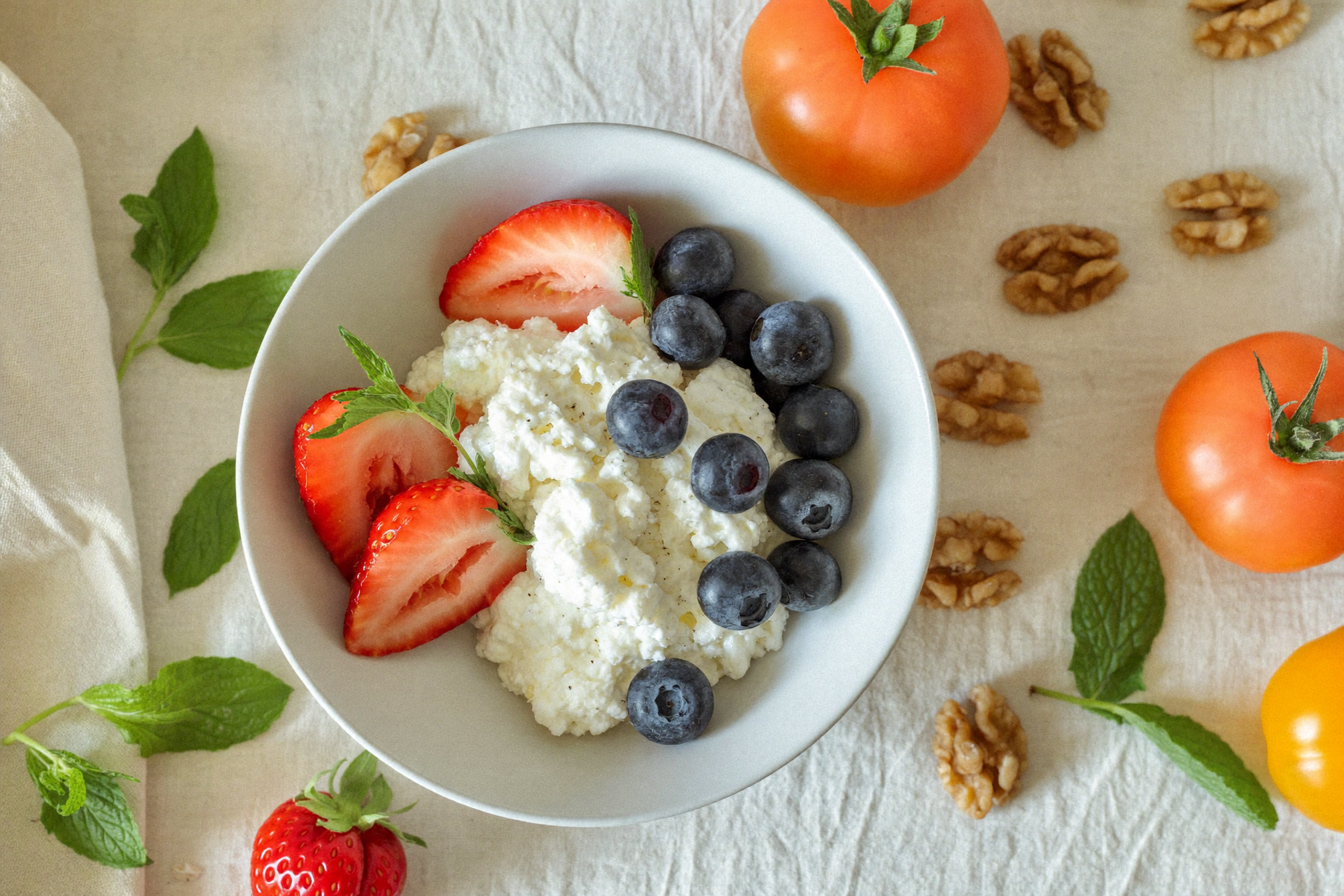
- Berry bowl — 150g cottage cheese with frozen or fresh blueberries and a small handful of walnuts. Good breakfast option that avoids the insulin spike of granola or oats eaten alone
- Blended into smoothies — adds protein without significantly changing flavour; works especially well with berries and a small amount of almond butter
- Overnight alternative to yogurt — layer with chia seeds and berries the night before for a ready breakfast
What to avoid
Not all cottage cheese is equal for PCOS. The main categories to avoid:
- Flavoured cottage cheeses — strawberry, pineapple, and peach varieties contain added fruit preparations, syrups, or sugars. Some have 8–12g of added sugar per serving, which directly opposes the low-GI principles of a PCOS diet
- Low-fat or fat-free versions — as above, the fat removal worsens the hormonal profile and often triggers the addition of starches or thickeners
- Cottage cheese with added starch — some brands use modified starch or maltodextrin as a thickener. Check the ingredient list: plain full-fat cottage cheese should contain milk, cream, salt, and possibly live cultures — nothing else
Cottage cheese vs Greek yogurt for PCOS
Both are good choices, and the difference is smaller than most comparison articles suggest. The practical differences:
- Protein — full-fat cottage cheese has slightly more protein per 100g than full-fat Greek yogurt (12g vs 10g). 0% Greek yogurt has more protein (17g per 100g) but loses the fat benefits
- Probiotics — Greek yogurt with live cultures provides gut bacteria that cottage cheese generally does not. For PCOS, gut microbiome diversity improves insulin sensitivity and reduces systemic inflammation — this is a meaningful difference in favour of Greek yogurt3
- Insulin response — yogurt's fermentation gives it a marginally lower insulin index than cottage cheese
- Versatility — cottage cheese works better in savoury cooked applications; Greek yogurt is better as a standalone snack or sauce base
The pragmatic answer: use both. Rotate them across the week so you get the probiotic benefit from Greek yogurt and the protein density from cottage cheese without relying on either exclusively.
Frequently asked questions
Is cottage cheese bad for PCOS?▼
How much cottage cheese should I eat with PCOS?▼
Is low-fat cottage cheese OK for PCOS?▼
Can I eat cottage cheese every day with PCOS?▼
Is cottage cheese better than Greek yogurt for PCOS?▼
Does cottage cheese spike insulin with PCOS?▼
References
- Moran LJ et al. (2013). Dietary composition in the treatment of polycystic ovary syndrome. J Acad Nutr Diet. PMID 23420000
- Bhattacharya A et al. (2015). Biological effects of conjugated linoleic acids in health and disease. J Nutr Biochem. PMID 25639270
- Tremellen K & Pearce K (2012). Dysbiosis of gut microbiota: a novel theory for the development of polycystic ovarian syndrome. Med Hypotheses. PMID 22543078
Full-fat cottage cheese. Built in, not optional.
HerMeal includes full-fat plain cottage cheese, Greek yogurt, and high-protein dairy where they fit your calorie and protein targets — personalised to your PCOS profile. Free to try.
Build my free plan