Magnesium and PCOS: Why You're Probably Deficient — and What to Do
How one overlooked mineral affects insulin resistance, cortisol, sleep, and period pain in PCOS — and how to get more of it.
Magnesium sits quietly in the background while iron and vitamin D get all the attention — but for women with PCOS, it may be the more consequential deficiency. Research consistently finds that women with PCOS have significantly lower serum magnesium levels than women without the condition, and the consequences reach well beyond the standard "tired and crampy" picture most people associate with low magnesium. Insulin resistance, cortisol dysregulation, poor sleep, and worsening androgen levels all have a direct connection to magnesium status. The good news: this is one of the most fixable nutritional problems in PCOS.
🔑 Key takeaways
- Women with PCOS are significantly more likely to be magnesium-deficient than women without PCOS
- Magnesium directly improves insulin sensitivity and reduces cortisol response — two core PCOS drivers
- Poor magnesium status worsens sleep quality, which in turn worsens insulin resistance — a compounding cycle
- Magnesium glycinate is the most bioavailable and best-tolerated form for daily use
- Dietary sources first, then supplement if intake is still below 300–350 mg/day
Contents
Why PCOS and magnesium deficiency go together
The connection isn't coincidental — it's mechanistic. Insulin resistance, which underlies most PCOS cases, causes the kidneys to excrete more magnesium in urine. The more insulin-resistant you are, the more magnesium you lose. And the more magnesium you lose, the worse your insulin resistance becomes. It's a bidirectional drain.
Research consistently finds lower serum magnesium levels in women with PCOS compared to healthy controls — a clinically meaningful difference that correlates with fasting insulin levels and HOMA-IR scores, reinforcing the insulin-magnesium feedback loop as the primary mechanism.
Compounding this: many of the foods that worsen PCOS — ultra-processed carbohydrates, refined grains, sugary drinks — are also among the lowest in magnesium. Women eating the typical Western diet who also have PCOS are often losing magnesium faster than they're taking it in.
Magnesium and insulin resistance: the direct link
Magnesium is a cofactor in over 300 enzymatic reactions, but for PCOS purposes, the most important is its role in glucose metabolism. Magnesium is required for the tyrosine kinase receptor — the first step in the insulin signalling cascade. Without adequate magnesium, cells respond less efficiently to insulin even when insulin levels are normal. This is why magnesium deficiency can cause or worsen insulin resistance independent of other dietary factors.
Supplementation research has shown measurable improvements in fasting glucose, fasting insulin, and HOMA-IR (a composite measure of insulin resistance) in populations with magnesium deficiency and metabolic syndrome — the closest comparable condition to PCOS metabolically. Supplementation research in women with PCOS and related metabolic populations has found that 250–300 mg/day of elemental magnesium can improve HOMA-IR and reduce fasting insulin compared to placebo.
Cortisol, sleep, and the magnesium connection
Magnesium has a direct regulatory role in the hypothalamic-pituitary-adrenal (HPA) axis — the system that controls cortisol output. When magnesium is low, cortisol levels rise in response to stressors that would otherwise produce a moderate response. For women with PCOS, this is a specific problem: elevated cortisol stimulates androgen production from the adrenal glands, layering adrenal androgens on top of the ovarian androgen excess already present in PCOS.
Studies in both humans and animal models consistently show that magnesium supplementation blunts the cortisol response to psychological and physiological stress. This doesn't mean it eliminates stress — it means the hormonal response is proportionate rather than exaggerated. For women with PCOS who already have a hair-trigger HPA axis, this matters.
Sleep quality
Magnesium is involved in the regulation of GABA receptors — the primary inhibitory neurotransmitter system responsible for quiet, restorative sleep. Low magnesium is associated with longer sleep onset time, more frequent night waking, and lower sleep quality scores. This matters for PCOS because poor sleep quality independently worsens insulin resistance — even one night of disrupted sleep measurably reduces insulin sensitivity the following day. If low magnesium is degrading your sleep, it's worsening your PCOS through a second pathway on top of the direct insulin signalling effect.
Taking magnesium glycinate 30–60 minutes before bed is one of the most consistently reported interventions for improving sleep quality — not by sedating you, but by supporting the neurological conditions your body needs to fall and stay asleep.
Period pain and androgens
Magnesium acts as a natural calcium channel blocker in smooth muscle — including the uterine muscle. Dysmenorrhea (period cramping) is partly caused by excessive prostaglandin-driven uterine contractions. Magnesium reduces both prostaglandin production and the strength of smooth muscle contractions triggered by prostaglandins. Multiple randomised trials on primary dysmenorrhea — painful periods without an identifiable structural cause — have found that magnesium supplementation reduces pain intensity and the need for NSAIDs like ibuprofen.
Women with PCOS also have elevated androgen levels, and some research suggests magnesium plays a role here too: it inhibits 5-alpha reductase, the enzyme that converts testosterone to its more potent form DHT. DHT drives hair loss, acne, and hirsutism — the androgen-related symptoms that many women with PCOS find most distressing. The evidence here is less robust than for insulin resistance, but mechanistically the pathway exists and is plausible.
Best food sources of magnesium for PCOS
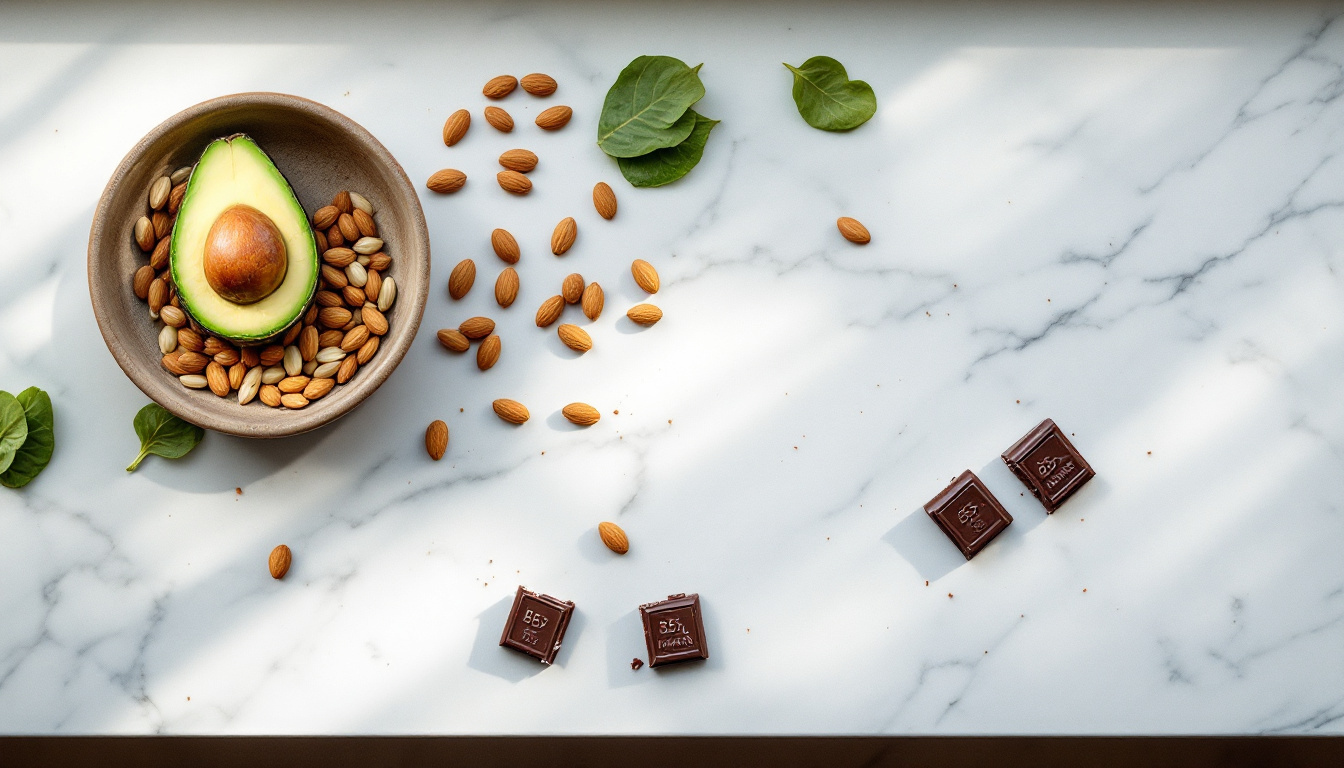
The best approach is always food first. These sources are also low-glycaemic and PCOS-friendly for reasons beyond magnesium alone:
| Food | Serving | Magnesium (mg) | Also provides |
|---|---|---|---|
| Pumpkin seeds | 30 g (small handful) | 168 mg | Zinc, iron, protein |
| Almonds | 30 g | 80 mg | Healthy fats, vitamin E |
| Cooked spinach | ½ cup | 78 mg | Folate, iron, fibre |
| Dark chocolate (70%+) | 30 g | 64 mg | Antioxidants, iron |
| Cooked black beans | ½ cup | 60 mg | Fibre, plant protein |
| Edamame | ½ cup | 50 mg | Complete plant protein |
| Avocado | ½ avocado | 29 mg | Monounsaturated fats, potassium |
| Banana | 1 medium | 32 mg | Potassium, B6 |
Hitting 300 mg/day from food is achievable but requires deliberate planning. A day that includes a small handful of pumpkin seeds, ½ cup of cooked spinach, 30g of almonds, and a portion of black beans would get you to roughly 350 mg — without supplementation. In practice, most women eating a varied whole-food diet land closer to 200–250 mg/day.
If you supplement: which form and how much
Not all magnesium supplements are equal — the form determines both how much you actually absorb and whether you experience GI side effects:
Magnesium glycinate (or bisglycinate)
This is the form most consistently recommended for PCOS and general supplementation. Magnesium is bound to glycine — an amino acid that has its own calming and sleep-supporting properties. Absorption is high, it causes minimal gastrointestinal upset even at higher doses, and the glycine component supports sleep quality independently. If you're choosing one form, choose this.
Magnesium citrate
Good absorption, widely available, and affordable. At higher doses (300 mg+), it has a mild laxative effect — which is sometimes a feature, not a bug. A reasonable option if you have no digestive issues at lower doses.
Magnesium malate
Magnesium bound to malic acid. Often marketed for fatigue and muscle pain — there's reasonable evidence for this in fibromyalgia populations. A secondary choice if you specifically deal with fatigue alongside PCOS.
Magnesium oxide — avoid
The cheapest and most commonly found form in drugstore supplements. Bioavailability is only around 4% — essentially it acts as a laxative rather than raising tissue magnesium levels. It's not useful for PCOS management.
Dosing
Start at 200–250 mg of elemental magnesium daily. Most magnesium glycinate capsules are 100–200 mg elemental magnesium per serving — check the label for "elemental magnesium" specifically, not total compound weight. Taking it with food reduces GI discomfort; taking it in the evening (30–60 min before bed) maximises the sleep benefit.
The tolerable upper intake level set by Health Canada and the NIH is 350 mg/day from supplemental sources (not counting food). Excess magnesium from supplements is excreted renally rather than accumulating — but doses above 400 mg from supplements can cause diarrhoea and GI cramping. Stay within the 200–350 mg/day supplement range unless directed otherwise by a healthcare provider.
Your plan, built around what your body actually needs
HerMeal builds 5-day PCOS and PMOS meal plans that prioritise magnesium-rich, low-glycaemic foods — personalised to your profile, cycle phase, and calorie target.
Generate your free planFrequently asked questions
Should women with PCOS take magnesium? ▼
How much magnesium should I take for PCOS? ▼
What type of magnesium is best for PCOS? ▼
Can magnesium help with PCOS period pain? ▼
What foods are highest in magnesium for PCOS? ▼