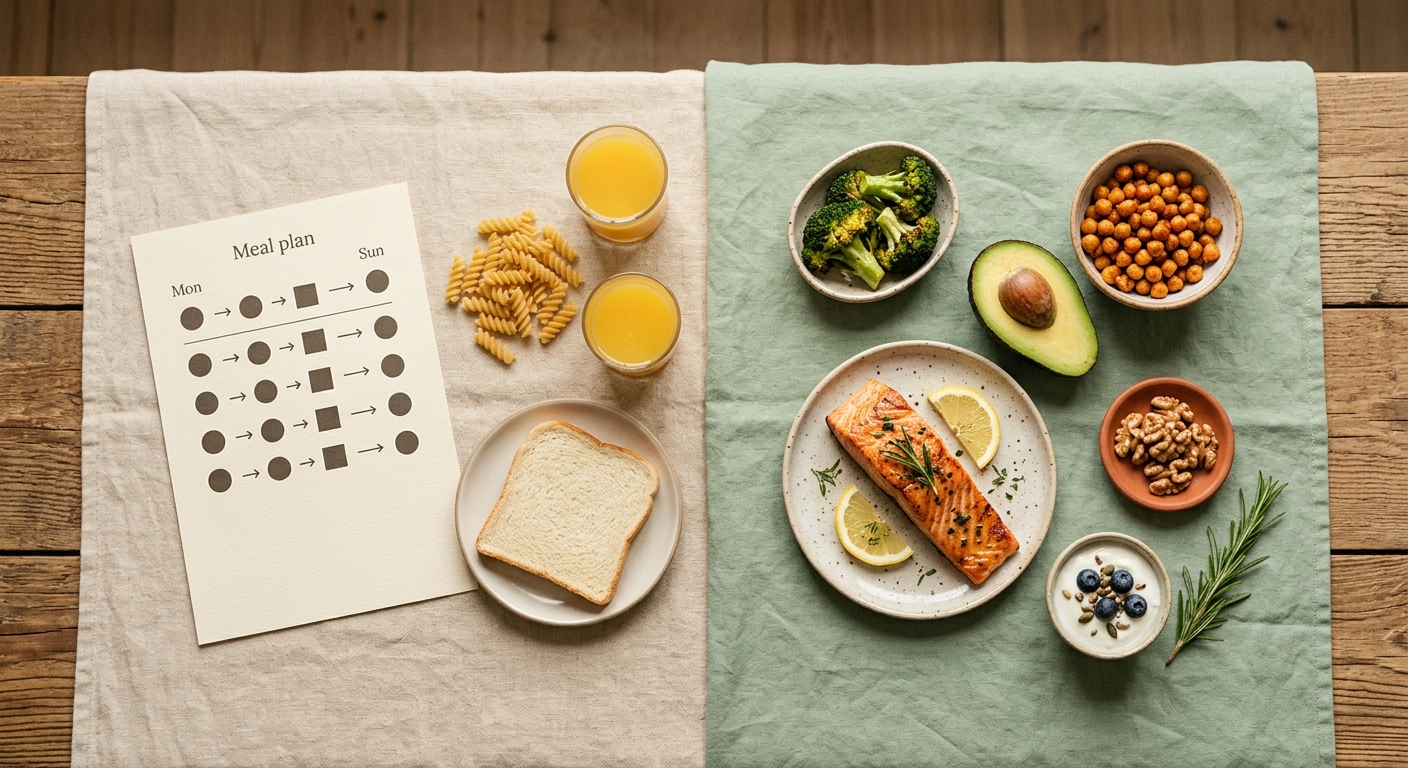
PCOS Meal Planner vs Generic AI Meal Plan What insulin resistance actually needs
Short answer: a generic AI meal planner optimises around whatever calorie or protein target you type in. A PCOS-specific planner is built around the two things that actually drive PCOS symptoms — insulin resistance and hyperandrogenism — and caps carbohydrates, anchors protein per kg body weight, and structures fibre accordingly. The difference is not marketing. It shows up in the plan.
In 2026 there are three distinct categories of AI meal planners marketing to women with PCOS: generic AI planners that accommodate PCOS as one of many conditions, static PCOS recipe databases that let you browse curated plans, and PCOS-native generators that build each plan fresh around your specific profile. They look similar on the landing page and behave very differently in practice. This post walks through what actually distinguishes them, what to check before you commit to one, and why the same daily calorie target can produce a plan that helps or a plan that quietly makes things worse.
🔑 Key takeaways
- Generic AI planners optimise around your inputs; PCOS-specific planners optimise around PCOS physiology (insulin, androgens, fibre)
- Static recipe libraries let you browse pre-built plans; generative tools build fresh plans around your specific profile each time
- The single biggest quality signal is whether the tool verifies macros against real ingredients or trusts LLM-generated numbers (a common failure mode)
- Protein should be anchored per kg body weight (1.2–1.6g/kg), not as a flat number — a 55kg and 90kg woman need very different amounts
- Free trials matter: you cannot evaluate the output from a landing page. If a tool requires a card to try, that is a signal
- Price is not a quality signal — several $29/month tools produce worse PCOS plans than free tools built around the right principles
Contents
- The Three Categories of AI Meal Planner in 2026
- What a PCOS Meal Plan Actually Needs
- Category 1: Generic AI Planners
- Category 2: Static PCOS Recipe Databases
- Category 3: PCOS-Native Generators
- Six Quality Signals to Check Before Committing
- Side-by-Side Comparison Table
- Cost vs Value: What You Get at Each Price Point
- Frequently asked questions
The Three Categories of AI Meal Planner in 2026
The AI meal planner space has grown quickly enough that most reviews still treat it as one product category. It isn't. The tools split cleanly into three groups that use overlapping words on their landing pages but produce very different outputs:
- Generic AI planners. One tool, many conditions. You pick your goal, the AI writes a plan. PCOS is listed alongside weight loss, muscle gain, meal prep optimisation, and other targets. The AI itself has no PCOS-specific model — it treats your condition as a constraint to accommodate rather than a physiology to design around.
- Static PCOS recipe databases. A large library of recipes tagged for PCOS suitability (often tens of thousands), and a planner that assembles weekly plans by pulling from the library. Personalisation happens by filtering the library. Nothing is generated fresh — you're picking from a fixed menu, however large.
- PCOS-native generators. Each plan is generated at request time, tailored to your specific profile (weight, protein target, allergies, fasting window, goal), with macro accuracy verified against a food database before the plan is returned. The AI is constrained by explicit PCOS-informed rules, not just prompted to write a "healthy meal plan."
All three categories describe themselves as "AI-powered" and "personalised." Only the third is actually generating fresh plans against a PCOS-specific rule set.
What a PCOS Meal Plan Actually Needs
Before comparing tools, it's worth being concrete about what "PCOS-friendly" means in nutritional terms. The 2023 international evidence-based guideline for PCOS assessment and management explicitly does not prescribe a single dietary pattern — it leaves macronutrient distribution to individual context.1 Separately, PCOS nutrition research and clinical practice have converged on a consistent set of features associated with improved insulin sensitivity, androgen levels, and cycle regulation:
- Protein at 1.2–1.6g per kg of body weight. This is higher than the general population recommendation because insulin resistance impairs muscle protein synthesis and adequate protein preserves lean mass in a calorie deficit — both matter for long-term metabolic health.
- Low glycaemic-index and low glycaemic-load carbohydrates. The mechanism is direct: high-GI foods produce larger insulin spikes, and insulin resistance means those spikes take longer to clear. Cumulative daily insulin exposure is what drives androgen production in the ovary.
- Fibre at 25g or more per day. Fibre slows glucose absorption, feeds the gut microbiome (which regulates androgen metabolism), and improves satiety at lower calorie loads.
- Reduced ultra-processed foods. Not for calorie reasons — for the compounding effects on insulin sensitivity, inflammation, and gut function.
- Adequate but not excessive fat. Fat itself is not the problem; the problem is calorie density when carbohydrates are also elevated. A balanced pattern with olive oil, nuts, and fatty fish supports hormone production without insulin load.
- Mediterranean-style overall pattern. The most consistent evidence for a specific dietary pattern reducing PCOS symptoms.
Notice what's absent: a specific calorie number, a required carb ceiling, a mandated fasting window. Those depend on the individual. What's fixed is the structure of the plan: protein per kg body weight, fibre floor, GI ceiling.
Category 1: Generic AI Planners
Generic AI meal planners are the largest category by user base. They market broadly — "meal plans for any goal or condition" — and rely on the underlying language model to accommodate PCOS when the user selects it as a condition. Examples in this category typically offer two free plans per month and paid tiers around $9–$15/month.
What they do well. Recipe variety, clean interfaces, decent grocery lists, and price. If you don't have a specific medical condition and just want a structured week of meals, they work fine. Their fresh generation model means you're not eating from the same rotation.
Where they fall short for PCOS. Three failure modes are consistent across the category:
- Protein target inconsistency. Generic planners typically ask for a flat protein number ("how much protein per day?") rather than calculating from body weight. Users unfamiliar with PCOS-specific targets often enter 60–80g, which is inadequate for maintaining muscle in a deficit at most body weights.
- No carbohydrate ceiling. The AI is given a calorie budget and produces a plan that hits it, without any structural limit on net carbs. It's common to see days that hit the calorie target with 200g+ net carbs from "healthy" sources like sweet potato, chickpeas, and quinoa — foods that are fine in moderation but produce cumulative insulin load when they anchor every meal.
- Macro fabrication. Pure LLM-generated plans that don't verify macros against a food database can output a recipe claiming 30g protein with ingredients that only supply 18g. This is not a bug; it's what happens when a language model does arithmetic. Without a verification layer, you eat what you eat, not what the plan says.
The result is that a generic planner can produce a fine plan for PCOS — if you happen to enter inputs that push it there and get lucky with the day's generation. Consistency is the missing piece.
Category 2: Static PCOS Recipe Databases
The second category takes the opposite approach: rather than generating fresh, build a library of pre-vetted recipes and let users browse and assemble weekly plans. Some players in this space claim tens of thousands of recipes (55,000+ in one prominent case), a PCOS phenotype quiz that segments users into insulin-resistant, inflammatory, adrenal, and post-pill types (a framework popularised by Lara Briden in The Period Repair Manual), and a range of related tools (symptom scorecards, cycle trackers, fertility guides).
What they do well. Depth of features. If you want a symptom log, cycle tracker, and PCOS-typed onboarding alongside meal ideas, the database category is currently ahead on breadth. The recipes themselves are usually PCOS-appropriate because they're curated rather than generated.
Where they fall short. Two structural limitations:
- Static recipes mean static plans. Even a library of 55,000 recipes cycles quickly at 21 meals per week. Users report the same rotations coming back within 6–8 weeks. Compare this to fresh generation, where every plan is new material.
- Personalisation is filtering, not authoring. Filtering a library by allergy, dietary preference, and phenotype narrows what shows up but doesn't produce a plan tailored to your specific macro targets, weight, or fasting schedule. You get "PCOS-friendly recipes that match your filters," not "a plan calibrated to your body."
The paid tiers for database platforms tend to be higher — typically $29/month for meal plan generation, though free tiers may include everything else. This price reflects the content investment (thousands of curated recipes plus tools), not necessarily a superior meal planning output.
Category 3: PCOS-Native Generators
The third category generates each plan fresh against explicit PCOS-informed rules: carbohydrate ceilings, protein-per-kg anchoring, fibre floors, macro verification against a real food database, and dietary preferences applied at generation time rather than filtered after. This is the category HerMeal sits in, and it's smaller than the other two because building it correctly is harder — you need both the generation logic and the verification layer, and the verification is where most fresh-generation tools cut corners.
What this category does well. Every plan is calibrated to the specific user: their weight (via protein-per-kg calculation), their calorie target, their fasting window, their allergies, their goal (fat loss, maintenance, muscle gain, fertility support), and their dietary preferences (vegetarian, halal, dairy-free, etc.). Macros are verified against a food database before the plan is returned, so what the plan says you're eating and what you're actually eating match.
The trade-off. Fewer features outside meal planning than the database category. If you want a symptom tracker, cycle log, or PCOS phenotype quiz built in, some PCOS-native generators have added these (HerMeal has an AI coach and wellness log; others don't) but the core competency is the plan itself.
Pricing. This category tends to be cheaper than static databases because the marginal cost of generation is low. Free tiers typically include 2 plans/month; paid tiers run $15–$20/month for unlimited generation.
Six Quality Signals to Check Before Committing
Regardless of category, six things separate PCOS meal planners that work from ones that don't. Run any tool you're evaluating through this list:
- Does it ask about your PCOS specifically, or just about your weight-loss goal? A planner that treats PCOS as a checkbox alongside "diabetes" and "hypertension" is a generic planner with a filter. A PCOS-native tool asks about symptom priorities (insulin, androgen, cycle regulation, fertility) because the plan changes based on which you emphasise.
- Does it cap net carbohydrates, or only count calories? Ask the free tier to generate a plan and check the total. If daily net carbs regularly exceed 180g, the tool has no structural carbohydrate ceiling.
- Does it anchor protein per kg of body weight, or as a flat number? A 55kg woman needs 65–90g protein daily; a 90kg woman needs 108–144g. A tool that gives both the same 80g default is not anchoring correctly.
- Does it verify macros against real ingredients? Look at any meal in a generated plan. Sum the protein, fat, and carbohydrate from each ingredient (a food database like USDA or NCCDB will get you close). If the totals match the meal's stated macros within 10%, verification is working. If they diverge by 20%+, the tool is trusting the LLM's arithmetic.
- Are dietary preferences and allergies collected before generation, not after? Some tools ask you to filter recipes after they're generated. A well-built tool asks first, so the plan is generated within your constraints from the start.
- Can you try it without a credit card? This is the single biggest signal. Any tool that requires a card to see the output is asking you to trust marketing rather than evaluate the product. Look for at least 1–2 free plans per month with no card required.
Side-by-Side Comparison Table
| Generic AI Planner | PCOS Recipe Database | PCOS-Native Generator | |
|---|---|---|---|
| Plan freshness | Fresh each time | Selected from library | Fresh each time |
| PCOS-specific structural rules | None (accommodates) | Recipe-level curation | Explicit generation rules |
| Protein anchoring | Flat number input | Per recipe, no target | Per kg body weight |
| Macro verification | Rarely | Pre-verified (curated) | Verified against food DB |
| Personalisation depth | Calorie + protein target | Filter library | Full profile calibration |
| Additional PCOS tools | Usually none | Symptom log, cycle, quiz | Varies by tool |
| Typical free tier | 2 plans / month | All tools except plans | 2 plans / month |
| Typical paid tier | $9–$15/month | $29/month | $15–$20/month |
Cost vs Value: What You Get at Each Price Point
Price is not a quality signal in this space. A $29/month tool can produce worse PCOS plans than a $9 tool if the $29 tool is a static database and the $9 tool is a PCOS-native generator. The relevant question is what you're paying for:
- Free tiers. Sufficient to evaluate the tool and generate 2–4 plans per month. If your cooking rotation is fine with two fresh plans per month and re-using the same recipes for the other weeks, a free tier can cover you indefinitely.
- Under $20/month. Usually buys unlimited generation, deeper personalisation, an AI coach at higher message limits, and support features. This is the sweet spot for PCOS-native generators.
- $25–$30/month. Typically the price of database-driven platforms with additional tools beyond meal planning — symptom trackers, fertility features, cycle logs, article libraries. Worth it if you want those adjacent tools; not necessary if you just want the meal plan.
Practical suggestion: Try one tool from each category on their free tier before paying. Generate a week from each, cook two meals from each, and see which one your body responds to. The plan that leaves you least hungry between meals, produces the steadiest energy through the day, and doesn't require you to correct the macros by hand is the one to keep. The others can go.
Try a PCOS-native plan, free
HerMeal builds fresh 5-day plans calibrated to your specific PCOS profile — protein per kg, carb ceilings, fibre floors, macros verified against a real food database. Works in any browser, no download.
Get your free planFrequently asked questions
What's the difference between a PCOS meal planner and a generic AI meal planner? ▼
Are AI-generated meal plans safe for PCOS? ▼
Is a PCOS meal plan just low-carb? ▼
Should I pay for a PCOS meal planner? ▼
Do PCOS meal planners work for weight loss? ▼
What should I look for in a PCOS meal planner? ▼
References
- Teede HJ et al. Recommendations from the 2023 International Evidence-based Guideline for the Assessment and Management of Polycystic Ovary Syndrome. Fertility and Sterility. 2023;120(4):767–793. PubMed ↗