Spearmint Tea and PCOS: Does It Lower Testosterone?
Two cups of spearmint tea daily significantly reduced free testosterone in a randomised controlled trial. Here's what the science actually says — and what it doesn't.
Spearmint tea sits in an unusual position in the PCOS supplement landscape: it is backed by actual clinical trial data — something the majority of herbal remedies marketed for PCOS cannot claim — but the evidence is also limited to a small number of short-duration studies. For women managing excess androgens, hirsutism, or scalp hair thinning, understanding both what the research shows and where its limits lie is more useful than either dismissing spearmint as a "wellness trend" or overstating what two cups a day can achieve. This article covers the full picture.
Key Takeaways
- A 30-day RCT found two cups of spearmint tea daily significantly reduced free testosterone in PCOS and hirsutism
- The mechanism involves inhibition of 5-alpha-reductase and direct anti-androgenic activity at the receptor level
- Spearmint also increased LH and FSH, suggesting improved gonadotropin signalling
- Two cups per day (Mentha spicata, not peppermint) is the evidence-backed dose
- Visible hirsutism improvement takes 3–6 months of consistent androgen reduction
- Evidence is promising but limited — spearmint tea is best used alongside dietary and lifestyle interventions
In this article
The clinical evidence
There are two key studies examining spearmint tea for androgen reduction in women:
Akdogan et al. (2007) — the pilot study
This Turkish study enrolled 21 women (12 with PCOS, 9 with idiopathic hirsutism) and gave them two cups of spearmint tea per day for five days. The results showed a statistically significant reduction in free testosterone, with no change in total testosterone. The researchers also noted a reduction in LH. While only a pilot study — short duration, small sample — it established the plausibility of spearmint's anti-androgenic effect in humans and prompted the more rigorous follow-up.
Grant (2010) — the randomised controlled trial
This is the most cited spearmint study in PCOS. Grant conducted a 30-day randomised controlled trial in 42 women with PCOS or idiopathic hirsutism. Participants were randomised to two cups of spearmint herbal tea or chamomile tea (the control) daily. The results:
- Free testosterone fell significantly in the spearmint group relative to chamomile
- LH increased significantly — indicating improved gonadotropin signalling toward the pituitary
- FSH increased significantly — consistent with better follicular stimulation
- Total testosterone was not significantly changed, suggesting the primary effect was on free (biologically active) androgen levels
- Self-reported hirsutism scores also improved in the spearmint group, though this subjective measure requires longer follow-up to be definitive
The study was published in Phytotherapy Research and has been repeatedly cited as the strongest existing evidence for spearmint's anti-androgenic effects in PCOS.
How spearmint lowers testosterone
Spearmint (Mentha spicata) contains several bioactive compounds, but the primary candidates for its anti-androgenic activity are rosmarinic acid, carvone, and a range of flavonoids.
5-alpha-reductase inhibition
5-alpha-reductase is the enzyme that converts testosterone into dihydrotestosterone (DHT) — the more potent androgen responsible for hirsutism (body and facial hair growth), androgenic alopecia (scalp hair thinning), and acne. Rosmarinic acid and several flavonoids in spearmint have demonstrated inhibitory activity against 5-alpha-reductase in laboratory studies. By reducing the conversion of testosterone to DHT, spearmint can reduce androgenic signalling at the tissue level even without dramatically lowering circulating total testosterone.
Androgen receptor antagonism
Some compounds in spearmint have demonstrated weak androgen receptor binding activity in cell studies — meaning they can compete with testosterone and DHT for receptor binding sites. This is a partial antagonist mechanism similar in principle (though very different in magnitude) to pharmaceutical antiandrogens like spironolactone. The clinical relevance of this mechanism from tea drinking is uncertain, but it may contribute to the reduction in free testosterone activity observed in the Grant trial.
LH and FSH effects
The increases in LH and FSH seen in the Grant trial suggest that spearmint may also act upstream in the hypothalamic-pituitary axis. Reduced androgen feedback to the pituitary can allow LH and FSH to rise — the same mechanism by which anti-androgenic medications often normalise gonadotropin ratios in PCOS. This is biologically consistent with the observed hormonal changes.
The dose and preparation
The evidence-backed protocol from the Grant (2010) trial is straightforward:
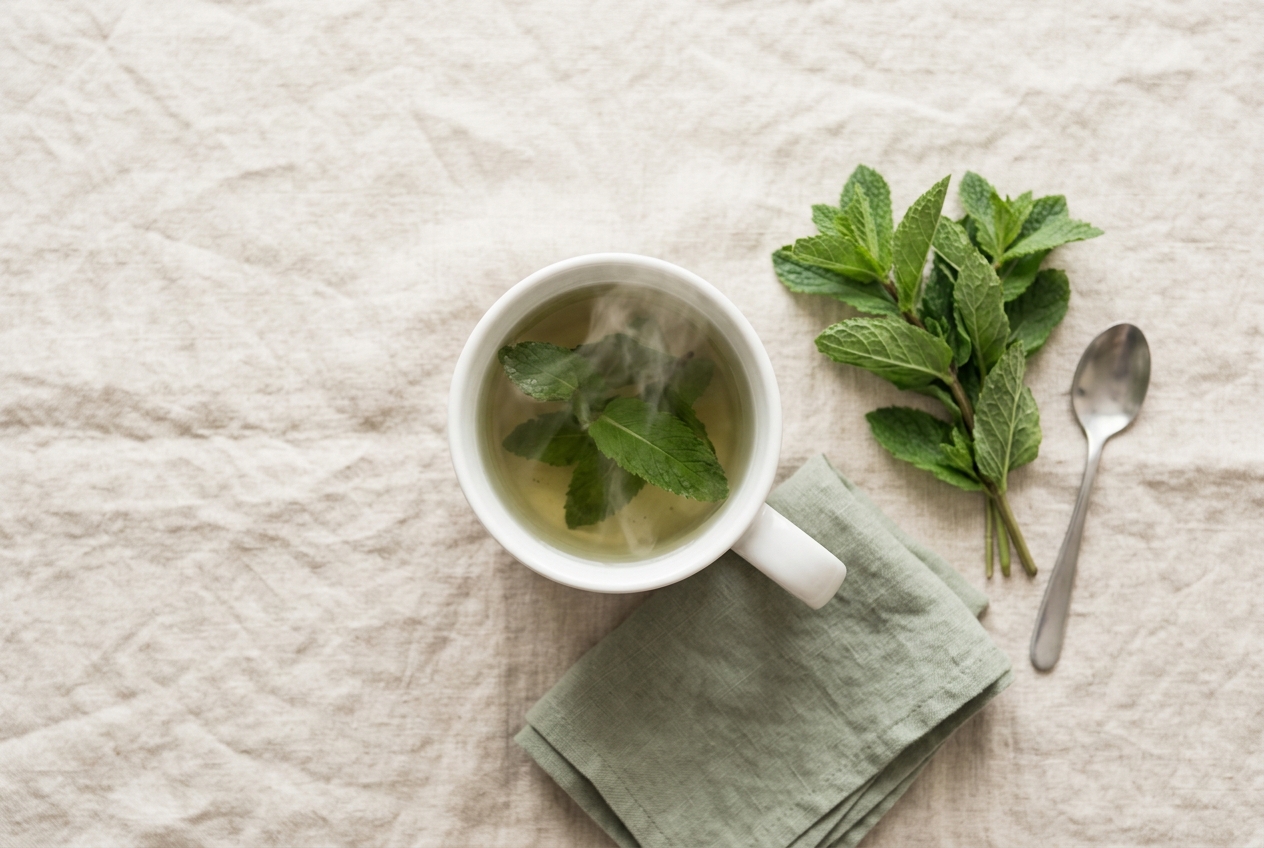
- Two cups per day — one in the morning, one in the evening
- One heaped teaspoon of dried spearmint leaves per cup (Mentha spicata)
- Steep in boiling water for 5 minutes, covered (covering retains volatile compounds)
- Drink while warm — no milk, as tannin binding is not a concern here but milk has not been studied in this context
Spearmint tea bags are a convenient alternative to loose leaf — most standard spearmint tea bags contain roughly one teaspoon equivalent of dried herb. The key is ensuring the product is Mentha spicata (spearmint) rather than Mentha piperita (peppermint) — they are different plants with meaningfully different active compound profiles.
Spearmint vs peppermint — why it matters
Spearmint and peppermint are different plants that are frequently confused. Mentha spicata (spearmint) contains carvone as its primary volatile compound, along with rosmarinic acid and specific flavonoids associated with the anti-androgenic effects. Mentha piperita (peppermint) is a hybrid of spearmint and watermint, with a significantly higher menthol content and a distinct phytochemical profile.
The clinical studies used spearmint exclusively. Peppermint has not been tested for anti-androgenic effects in PCOS and should not be assumed to be equivalent. If you have been drinking peppermint tea thinking it is equivalent to the studied intervention, switch to spearmint.
Spearmint for hirsutism
Hirsutism — unwanted dark, coarse hair growth on the face, chest, abdomen, and back — is one of the most distressing symptoms of androgen excess in PCOS. It is caused by DHT stimulating androgen-sensitive hair follicles to produce terminal (thick, pigmented) hair in areas typically only active in men.
Spearmint tea's anti-androgenic mechanism — particularly its 5-alpha-reductase inhibition — targets the correct pathway for hirsutism management. However, a critical point for realistic expectations: existing terminal hair follicles do not immediately revert when androgen levels fall. They require months of reduced DHT stimulation before miniaturising back toward finer hair. The Grant (2010) study was only 30 days, which is far too short to observe meaningful visible hair reduction — participants reported improved subjective hirsutism scores, but this likely reflects slowing of new growth rather than reversal of existing hair.
Visible hirsutism improvement from any anti-androgenic intervention — including prescription spironolactone — typically takes 3–6 months of consistent use. Spearmint tea, at two cups per day, should be viewed as a gentle, accessible long-term intervention in this context rather than a fast-acting solution.
Spearmint for PCOS-related hair loss
Androgenic alopecia (scalp hair loss driven by DHT) in PCOS operates through the same DHT mechanism as hirsutism, but in the reverse direction — DHT miniaturises scalp follicles rather than stimulating body follicles. Spearmint's 5-alpha-reductase inhibition is therefore mechanistically relevant to scalp hair loss as well.
No clinical trials have specifically examined spearmint tea for PCOS-related androgenic alopecia. The evidence is mechanistic and indirect. Women using spearmint tea as part of a broader androgen-management strategy — alongside dietary changes, inositol, and adequate iron and ferritin levels — may see slowed progression of scalp hair thinning over months of consistent use. It is unlikely to regrow already-lost hair; its primary value is reduction of DHT-mediated follicle damage going forward.
Who benefits most
Spearmint tea's anti-androgenic mechanism is most relevant for women with PCOS who have elevated androgen markers — elevated free testosterone, DHEAS, or clear clinical signs of androgen excess (hirsutism, hormonal acne, androgenic alopecia). The Grant study enrolled women with confirmed PCOS or idiopathic hirsutism, and the effect size was most meaningful in those with elevated free testosterone at baseline.
Women with PCOS who have normal androgen levels (some lean PCOS phenotypes are driven by ovarian morphology and menstrual irregularity without significant androgen elevation) may see less benefit from a specifically anti-androgenic intervention like spearmint tea. In that context, the tea is still harmless and pleasant, but the physiological target may be less active.
Limitations of the evidence
The honest limitations of the spearmint evidence are worth stating clearly:
- Small sample sizes: Both key studies had fewer than 45 participants. Effect sizes should be interpreted with caution until replicated in larger trials.
- Short duration: 30 days is not enough time to assess most clinically meaningful PCOS outcomes (hirsutism reversal, menstrual cycle changes, fertility).
- No long-term safety data: Two cups of herbal tea per day is unlikely to pose risks, but no study has examined effects beyond 30 days.
- No standardisation: Spearmint tea products vary in rosmarinic acid and carvone content. The "dose" from different brands may not be equivalent to what was used in trials.
- No PCOS-specific fertility data: The mechanism is plausible, but spearmint tea has not been tested as a fertility intervention in PCOS.
Combining spearmint with other PCOS interventions
Spearmint tea is best understood as a low-risk, evidence-supported addition to a broader PCOS management approach — not as a standalone treatment. Its anti-androgenic mechanism complements rather than duplicates:
- Myo-inositol — works on insulin signalling and reduces androgen from the ovary via a different pathway; the two are complementary
- Low-GI, high-protein diet — reduces hyperinsulinaemia, which is one of the main drivers of ovarian androgen overproduction; spearmint does not address this directly
- Exercise — improves insulin sensitivity and SHBG; again complementary, not overlapping
- Magnesium and zinc — support insulin sensitivity and have some anti-androgenic properties; can be stacked with spearmint
Women using prescription anti-androgens (spironolactone, cyproterone acetate) should discuss adding spearmint tea with their prescribing doctor — not because of known interactions, but because stacking multiple anti-androgenic interventions can produce additive effects on androgen levels that may need monitoring.
Build your personalised anti-androgen PCOS meal plan
HerMeal creates 5-day PCOS meal plans built around low-GI, high-protein, anti-inflammatory principles — the dietary counterpart to everything in this article. Ready in minutes.
Start freeFrequently Asked Questions
Does spearmint tea really lower testosterone in PCOS? ▼
Yes — there is clinical trial evidence showing that spearmint tea reduces free testosterone in women with PCOS and hirsutism. The most rigorous study (Grant, 2010) was a 30-day randomised controlled trial in which women drinking two cups of spearmint tea daily experienced a significant reduction in free testosterone and an increase in LH and FSH. This suggests a real anti-androgenic mechanism. However, the trial lasted only 30 days, so long-term symptom impact is inferred rather than directly measured.
How much spearmint tea should I drink for PCOS? ▼
The dose used in the randomised controlled trial was two cups per day — one in the morning and one in the evening — each made by steeping one heaped teaspoon of dried spearmint leaves in boiling water for 5 minutes. Spearmint tea, not peppermint tea, is the studied variety — peppermint has a different active compound profile and no equivalent clinical evidence for anti-androgenic effects.
How long does spearmint tea take to work for PCOS? ▼
The 30-day Grant (2010) trial showed measurable reductions in free testosterone within 30 days. However, visible symptom improvement — particularly reduction in unwanted hair growth — typically takes 3–6 months of sustained androgen reduction, because existing hair follicles take months to miniaturise. Measurable hormonal changes may appear sooner but symptom changes are slower.
Is spearmint tea safe for PCOS? ▼
Spearmint tea is generally very safe at two cups per day. No significant adverse effects were reported in the clinical studies. Women who are pregnant or actively trying to conceive should consult their GP before using spearmint tea consistently, as spearmint has traditional emmenagogue uses. For general PCOS symptom management, two cups per day appears safe.
Can spearmint tea help with PCOS hair loss? ▼
Potentially — if the hair loss is androgen-driven. Spearmint's anti-androgenic mechanism (5-alpha-reductase inhibition) targets the DHT pathway responsible for androgenic alopecia in PCOS. Clinical trials focused on hirsutism rather than scalp hair loss, so the evidence for hair loss specifically is indirect. The mechanism is the same, and reducing free testosterone and DHT is the correct target for androgen-driven hair thinning.
Does spearmint tea affect fertility in PCOS? ▼
Spearmint tea has never been tested specifically as a fertility intervention in PCOS. The LH and FSH increases observed in the Grant trial are consistent with improved gonadotropin signalling, which could support follicle development. Women trying to conceive should combine spearmint tea with other evidence-backed interventions and consult their GP.
Is spearmint tea or spearmint supplements better for PCOS? ▼
The clinical trials used spearmint tea (the infusion), not supplements. Tea is the evidence-backed form. Spearmint supplements exist but have not been studied for PCOS to the same standard. Spearmint oil should not be used internally — concentrated essential oils are not equivalent to tea infusions and carry different risk profiles.
References
- Grant P. (2010). Spearmint herbal tea has significant anti-androgen effects in polycystic ovarian syndrome. A randomized controlled trial. Phytotherapy Research. pubmed.ncbi.nlm.nih.gov/19585478
- Akdogan M, et al. (2007). Effect of spearmint (Mentha spicata Labiatae) teas on androgen levels in women with hirsutism. Phytotherapy Research. pubmed.ncbi.nlm.nih.gov/17704979
- Abe F, et al. (2002). Antiandrogenic activity of rosmarinic acid from spearmint extracts. Natural Product Research. Referenced in Grant (2010) mechanistic discussion.
- Teede HJ, et al. (2023). Recommendations from the 2023 international evidence-based guideline for the assessment and management of polycystic ovary syndrome. Human Reproduction. pubmed.ncbi.nlm.nih.gov/37580037