PCOS Lunch Ideas 12 High-Protein Meals Under 500 Calories
Short answer: the best PCOS lunch has 30–40g of protein, 15–30g of net carbohydrates, plenty of non-starchy vegetables for fibre, and travels well. Every recipe below hits all four, sits under 500 calories, and is designed for the workday — four are batch-cookable, three are salad jars, three are wraps, and two are freezable soups.
Lunch is where PCOS diets most often collapse. Not because it's hard to think of ideas — but because by 12pm, you're already at work, already low on energy, and the closest food is a coffee shop wrap or a takeaway salad that spikes your insulin and leaves you hungry an hour later. The fix isn't willpower. It's setting up a working library of lunches that meal-prep well, travel in a bag, and don't need reheating — so the “what do I eat?” decision is answered before Monday morning starts. This is that library: 12 lunches built around PCOS macros (30–40g protein, controlled carbs, high fibre), all under 500 kcal, all supermarket ingredients.
🔑 Key takeaways
- Every recipe hits 30–40g protein, under 500 calories, and 15–30g net carbs — the pattern that prevents the 3pm energy crash
- 4 formats represented: bowls (portable + reheatable), salad jars (5-day fridge life), wraps (5-min assembly), soups (freeze for weeks)
- 6 cuisines across the 12 recipes so lunch doesn't feel like the same meal five days a week
- Recipes 2, 4, 9, 10 are batch-cook-once formats — Sunday prep gives you 4 lunches
- Every ingredient is a standard supermarket item — no specialty stores
- Macros are per serving — adjust portions if your calorie target differs (~1,500 daily = 400 kcal lunch, ~1,800 daily = 500 kcal lunch)
Contents
Three things every PCOS lunch needs
Before the recipes, the pattern behind them. Lunch has three requirements that are different from dinner — understand these and you can adapt any lunch idea you find online to work for PCOS.
1. 30–40 grams of protein, minimum
Same target as dinner, and for the same reason: protein has the lowest insulin response of the three macronutrients, blunts the glucose spike from any carbs, and prevents the mid-afternoon energy crash that drives snacking. For most women with PCOS, 1.2–1.6g of protein per kilogram of body weight per day is the target used in PCOS nutrition research and clinical practice — 50-100% higher than the general population RDA. The 2023 international PCOS guideline does not prescribe a specific protein target but supports a lifestyle-first approach to managing insulin resistance.1
Realistic single-serving amounts that hit 30–40g at lunch: 150g cooked chicken breast, 180g salmon, 3 large eggs plus 100g Greek yogurt, 200g cottage cheese, 200g firm tofu, 150g cooked prawns, 100g cooked lentils plus 50g feta.
2. Controlled net carbs (15–30g) from low-GI sources
Lunch net carbs should sit lower than dinner — 15–30g rather than 30–40g. Reason: the afternoon energy crash. High-carb lunches spike glucose, insulin overcorrects, and by 3pm you're crashing, reaching for coffee or a biscuit, and the whole day's blood sugar is destabilised. Lower carbs at lunch = steadier afternoon = no snack drift.
Lunch carbs should come from: quinoa (60g cooked = ~13g net), lentils (80g cooked = ~13g net), chickpeas (80g cooked = ~15g net), a small portion of whole-grain wrap or sourdough (30g of bread = ~13g net), or half a sweet potato (100g cooked = ~15g net). Skip white rice, refined pasta, and sandwich bread — they hit blood sugar too fast for a workday.
3. It has to travel
Dinner gets to be cooked-on-the-day. Lunch usually doesn't — not on a workday, not for someone with a real schedule. The best PCOS lunches meet three practical criteria: they hold in a fridge for 3–5 days without going limp; they don't require reheating (or reheat well in a microwave); and they can be eaten at a desk without a plate. That constraint is why bowls, jars, wraps, and soups dominate this list.
The 30-second lunch sanity check: can I pack this in a container the night before? Does the protein hold overnight in the fridge (some fish and rare beef don't)? Will I eat it cold or does it need reheating? If yes to the first two and no to the third, it's a working lunch. Anything requiring reheating for texture (crispy chicken, pasta) is a dinner in disguise.
The 12 recipes
All macros are per one serving. If you're batch-cooking, divide the total by the number of servings noted at the top of the recipe. Adjust portions to your calorie target if needed — 400 kcal lunch fits a 1,500 kcal day, 500 kcal fits a 1,800 kcal day.
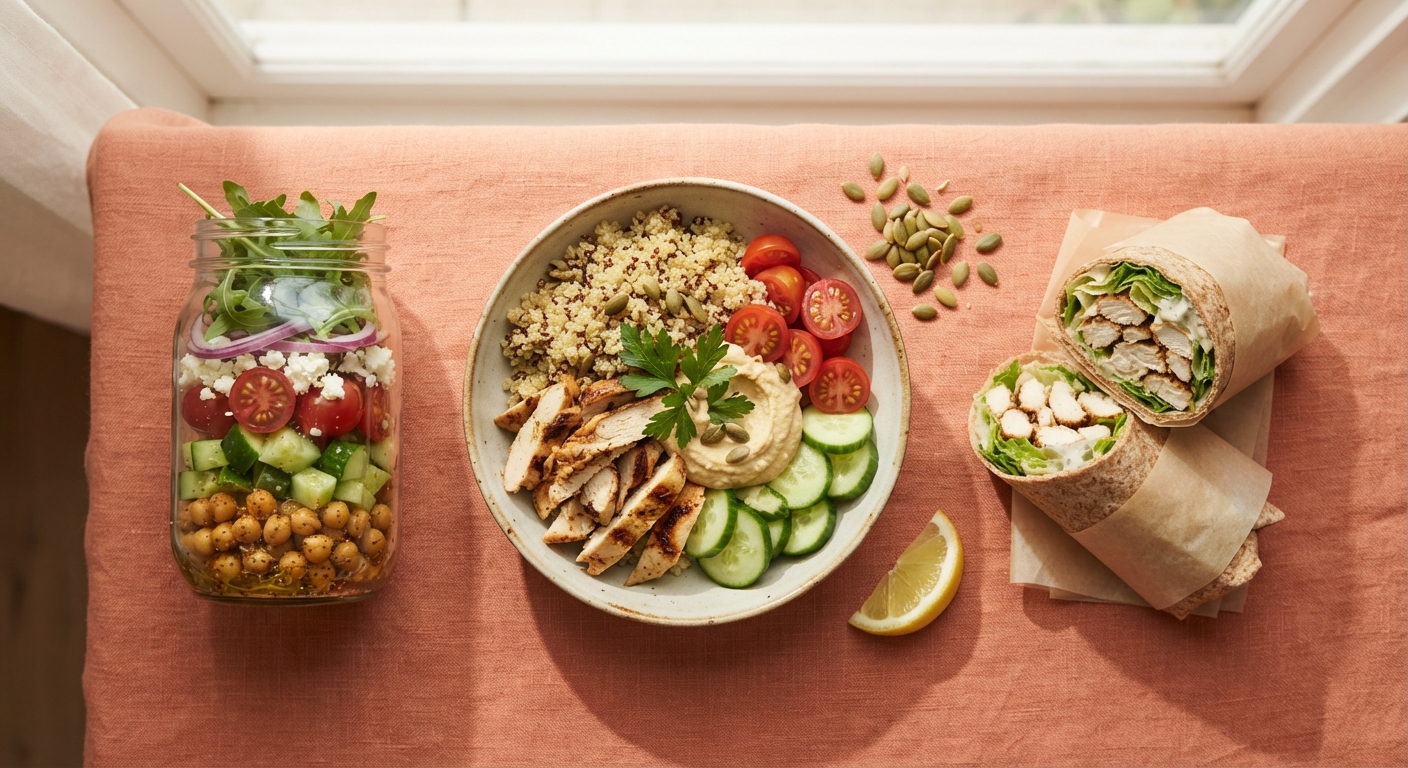
Mediterranean Chickpea & Feta Salad Jar
Mediterranean · salad jarServes 1 · 10 min · keeps 4 days in fridge
Layer bottom to top in a wide-mouth mason jar
- Dressing: 60g Greek yogurt (2% fat) + 1 tbsp lemon juice + oregano + salt + a touch of Dijon (Greek yogurt does the emulsifying job olive oil normally does — keeps calories in check)
- 100g cooked chickpeas (drained tinned)
- 100g diced cucumber
- 80g cherry tomatoes, halved
- 30g red onion, finely sliced
- 60g crumbled feta
- 1 hard-boiled egg, quartered
- Large handful of rocket or spinach on top
To eat
- Shake the jar to distribute dressing, or empty into a bowl and toss.
- The greens on top stay dry until serving — that's why they don't wilt for 4 days.
Chicken Shawarma Grain Bowl
Middle Eastern · batch-cookServes 4 · 30 min prep + 25 min bake · make Sunday, eat Mon–Thu
Ingredients (4 servings)
- 600g boneless skinless chicken thighs
- Marinade: 2 tbsp olive oil, 2 tsp cumin, 2 tsp coriander, 1 tsp smoked paprika, 1 tsp turmeric, juice of 1 lemon, 3 grated garlic cloves, salt
- 240g cooked quinoa (60g per serving)
- 1 cucumber, diced
- 200g cherry tomatoes, halved
- 60g pickled turnips or red cabbage
- 4 tbsp hummus (30g per serving)
- Parsley, mint, lemon wedges
Method
- Marinate chicken 30 min minimum. Bake at 220°C for 20–25 min. Rest 5 min, slice.
- Cook quinoa in advance (250g dry gets you ~750g cooked, more than enough).
- Assemble 4 containers: quinoa base, cucumber + tomato on one side, sliced chicken on top, hummus in a corner. Pickled veg in a small pot.
- Herbs and lemon wedges packed separately — add at lunch for freshness.
Korean-Style Beef Bowl with Kimchi
Korean · batch-cookServes 3 · 25 min · reheats or eats cold
Ingredients (3 servings)
- 400g lean beef mince (5% fat)
- 3 tbsp low-sodium soy sauce
- 1 tbsp gochujang
- 2 tsp sesame oil, 1 grated garlic clove, 1 tsp grated ginger
- 1 tsp honey
- 180g cooked brown rice (60g per serving)
- 150g kimchi (50g per serving)
- Steamed broccoli or sugar snap peas (150g per serving)
- 1 tsp toasted sesame seeds, sliced spring onion
Method
- Brown beef in a dry pan 6–8 min. Drain excess fat.
- Add soy, gochujang, sesame oil, garlic, ginger, honey. Simmer 3 min until glossy.
- Portion into 3 containers: rice base, beef on top, broccoli beside, kimchi in a corner.
- Top with sesame + spring onion. Eat cold or microwave 60s.
Turkey & Quinoa Stuffed Peppers
Latin · batch-bake · freezesServes 4 · 45 min · make Sunday, freeze half for later weeks
Ingredients (4 servings)
- 4 large bell peppers (any colour), tops sliced off, seeds removed
- 500g lean ground turkey (7% fat)
- 200g cooked quinoa
- 1 tin diced tomatoes
- 1 onion diced, 2 garlic cloves
- 1 tsp cumin, 1 tsp smoked paprika, 1 tsp oregano
- 60g grated cheese (cheddar or Monterey Jack)
- Fresh coriander, lime, salt, pepper
Method
- Cook onion 5 min, add turkey, brown 8 min. Add garlic, spices; cook 1 min.
- Stir in tomatoes and quinoa. Simmer 5 min until thick. Season.
- Stand peppers upright in a baking dish. Fill with turkey mix. Top with cheese.
- Bake 200°C for 25–30 min. Cool, portion into containers.
- Fridge keeps 4 days. Freezer keeps 2 months. Reheat 2 min in microwave.
Salmon Poke Bowl with Edamame
Asian · bowlServes 1 · 10 min · use sashimi-grade salmon (or seared for safety)
Ingredients
- 150g sashimi-grade salmon, cubed (or seared salmon fillet, flaked)
- 60g cooked brown rice or 100g cooked quinoa
- 80g shelled edamame (frozen, defrosted)
- 100g cucumber, sliced
- 1/4 avocado (~40g)
- 1 tbsp soy sauce + 1 tsp sesame oil + 1 tsp rice vinegar (dressing)
- Nori strips, sesame seeds, sliced spring onion
Assembly
- Grain base in bottom of container.
- Arrange salmon, edamame, cucumber, avocado on top.
- Dressing packed separately (soy loses punch overnight in the container). Add at lunch.
- Top with nori, sesame, spring onion. Best eaten day of, but keeps 24h.
Chicken Caesar Wrap (Whole-Wheat)
American · wrap · 5 minServes 1 · 5 min · assemble morning-of
Ingredients
- 1 whole-wheat tortilla (30cm, high-fibre if possible)
- 130g cooked chicken breast, sliced or shredded
- 2 tbsp Caesar dressing (Greek-yogurt-based is lower calorie)
- Large handful of romaine or cos, shredded
- 15g shaved parmesan
- 2 boiled anchovy fillets (optional but authentic)
- Black pepper, lemon squeeze
Assembly
- Warm tortilla in a dry pan 30 sec each side (makes it foldable, doesn't crack).
- Spread Caesar dressing over the tortilla.
- Layer romaine, chicken, parmesan, anchovies, black pepper, lemon.
- Fold sides in, roll tightly from the bottom. Wrap in foil or parchment. Slice in half.
White Bean & Tuna Salad on Sourdough
Mediterranean · open sandwich · 5 minServes 1 · 5 min · store components, assemble at desk
Ingredients
- 1 tin tuna in olive oil, drained (~100g)
- 80g cooked cannellini or white beans (drained tinned)
- 2 tbsp red onion, finely diced
- 1 tbsp capers
- 1 tbsp olive oil + 1 tsp lemon juice + parsley
- 1 large slice sourdough (~40g)
- Rocket or watercress on top
- Cracked black pepper
Method
- Mix tuna, beans, onion, capers, oil, lemon, parsley in a container. Fridge overnight if prepping.
- Pack sourdough separately. At lunch: pile tuna mix on the bread, top with rocket, pepper.
- Alternative: skip the bread entirely and eat over a bed of extra rocket — drops carbs to 8g.
Vietnamese Shredded Chicken Rice Paper Rolls
Vietnamese · light + freshServes 1 · 15 min · assemble morning-of, eat cold
Ingredients (makes 4 rolls)
- 4 rice paper wrappers (22cm)
- 120g cooked shredded chicken breast
- 60g vermicelli rice noodles, cooked
- 1 carrot, julienned
- Half a cucumber, julienned
- Handful of mint + coriander leaves
- Lettuce leaves (butter or gem)
- Dipping: 2 tbsp peanut butter + 1 tbsp soy + 1 tsp sriracha + juice of half a lime + 1 tbsp warm water to thin
Method
- Dip rice paper in warm water 10 sec until pliable. Lay flat on a clean surface.
- Layer lettuce, noodles, chicken, carrot, cucumber, herbs. Fold sides, roll tightly.
- Wrap in damp paper towel + foil for the fridge (stops sticking).
- Peanut sauce in a small pot. Dip and eat — keeps 24h.
Greek Chicken Souvlaki with Tzatziki
Greek · batch-cook · reheatServes 4 · 20 min prep + 15 min grill + marinade · batch Sunday
Ingredients (4 servings)
- 600g boneless chicken thighs, cubed
- Marinade: 3 tbsp olive oil, juice of 1 lemon, 2 tsp oregano, 3 garlic cloves grated, salt, pepper
- Tzatziki: 300g Greek yogurt, half a grated cucumber (squeezed dry), 1 garlic clove, 1 tbsp mint, salt
- 4 small whole-wheat pitta breads (30g each)
- Salad: 200g cherry tomatoes, half a red onion sliced, 60g crumbled feta, olives
Method
- Marinate chicken 30 min. Grill 12–15 min in a pan or under a broiler until cooked through.
- Mix tzatziki. Chop salad ingredients.
- Portion into 4: chicken, salad, tzatziki in a small pot, pitta wrapped separately.
- At lunch: warm pitta 20 sec in microwave, stuff with chicken, salad, tzatziki. Or eat deconstructed — less carbs (skip pitta = 10g net).
Red Lentil Soup with Turmeric & Ginger
Middle Eastern · batch + freezeServes 5 · 35 min · freezes 3 months
Ingredients (5 servings)
- 300g dried red lentils, rinsed
- 1 onion diced, 3 garlic cloves grated, 1 tbsp grated ginger
- 2 carrots diced
- 1 tbsp olive oil
- 1 tsp turmeric, 2 tsp cumin, 1 tsp coriander, pinch of chilli
- 1.2L vegetable stock
- 1 tin coconut milk (light, 200ml) — or use full-fat 100ml for creamier
- Juice of 1 lemon
- Protein per serving: top with 100g Greek yogurt OR 100g cooked chicken (chopped) OR a boiled egg + 30g feta
Method
- Sweat onion, garlic, ginger, carrots in olive oil 8 min.
- Add spices 30 sec. Add lentils, stock. Simmer 20 min until lentils dissolve.
- Add coconut milk, lemon. Blend smooth or leave chunky.
- Portion into 5 containers. Fridge 4 days, freeze 3 months.
- Protein comes at serving — soup itself is legume-based (~12g/serving), needs a topper to hit 30g.
Egg Salad & Avocado Wrap
American · wrap · 5 minServes 1 · 5 min · keeps 24h
Ingredients
- 3 boiled eggs, chopped
- 60g cottage cheese (protein boost + creaminess without loads of mayo)
- 1 tbsp mayo
- 1 tsp Dijon mustard
- 1 spring onion, sliced
- Salt, pepper, paprika
- 1 whole-wheat tortilla
- 1/4 avocado, sliced
- Spinach or rocket
Method
- Mash eggs with cottage cheese, mayo, mustard, spring onion, salt, pepper, paprika.
- Spread on the tortilla, add avocado, spinach.
- Roll tightly. Wraps travel better if wrapped in foil.
Miso Salmon & Broccoli Bento
Japanese · meal-prep · freezesServes 3 · 20 min · reheats cold or 90 sec microwave
Ingredients (3 servings)
- 3 x 150g salmon fillets
- Glaze: 2 tbsp white miso, 1 tbsp mirin, 1 tsp honey, 1 tsp soy sauce
- 400g broccoli florets
- 180g cooked brown rice (60g per serving)
- Pickled ginger, sesame seeds, sliced spring onion
- 1 tsp sesame oil for broccoli
Method
- Whisk miso glaze. Brush over salmon fillets.
- Bake salmon at 200°C for 10–12 min. Steam broccoli 5 min, toss with sesame oil.
- Portion into 3 bento boxes: rice on one side, salmon in the middle, broccoli in another compartment. Pickled ginger and sesame + spring onion in a small corner.
- Fridge 3 days. Eat cold (Japanese-style) or 90 sec microwave for warm.
The Sunday-prep routine: 4 lunches in 60 minutes
The single most effective habit for keeping to any PCOS eating plan is Sunday meal prep — specifically, using one 60-minute block to lock in Monday-through-Thursday lunches. Here's how to structure it:
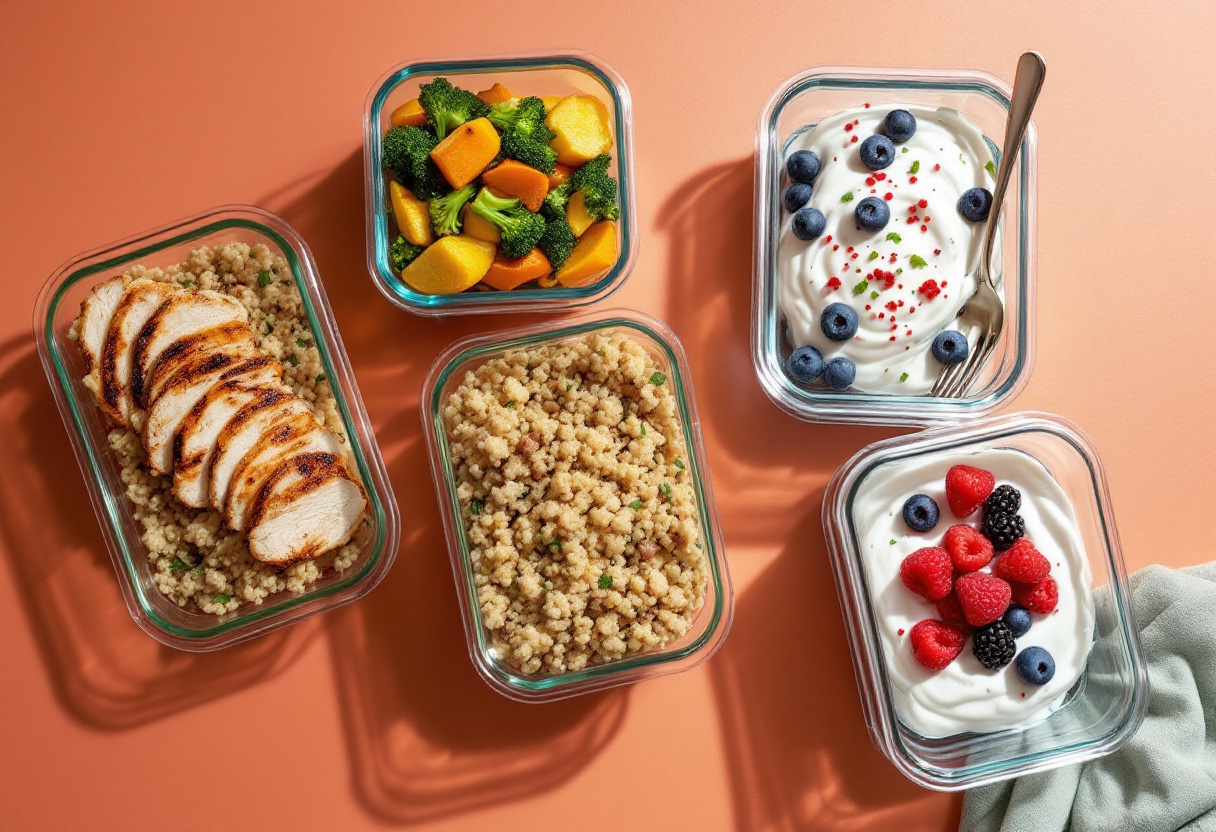
- Pick one batch-cook recipe. Any of recipes 2, 3, 4, or 9 gives you 3–4 servings in a single cook session. Choose one; that's your Sunday project.
- Cook the protein first. Chicken shawarma marinating (30 min) → into the oven; while it bakes, prep everything else. Turkey stuffed peppers assemble in 15 min → 30 min bake; use that 30 min for step 3.
- Cook the grain in bulk. 200g dry quinoa gives you ~600g cooked = enough for 6 servings across the week (lunch + a couple of dinners). Same for brown rice.
- Chop all the veg for the week. Cucumber, tomato, peppers, red onion, kimchi — get them into containers so morning-of assembly is 3 minutes.
- Portion, seal, refrigerate. 4 identical containers = 4 lunches. Kimchi, dressings, and hummus in tiny separate pots (avoids everything tasting the same).
60 minutes on Sunday, 4 lunches you don't have to think about until Friday. If Friday lunch needs to be different for variety, use one of the 5-minute recipes (6, 7, 11) — assemble morning-of from staples.
The 3-jar / 1-cook rule: most weeks alternate between two patterns — a batch-cook Sunday for hot lunches (recipes 2, 3, 4, 9, 10, 12), or a "salad jar Sunday" where you prep 3 mason jar salads (recipe 1 and variations) that keep 4 days. Alternating weeks stops flavour fatigue. See our full PCOS meal prep guide for the complete Sunday routine including breakfast and dinner components.
When to eat lunch (and what happens when you skip)
Between 12pm and 2pm works well for most women with PCOS. If you're intermittent fasting (16:8, eating window noon to 8pm), lunch is your first substantial meal — and should be your largest protein-forward meal of the day. If you eat a full breakfast, lunch can be slightly lighter (400–450 kcal instead of 500).
Skipping lunch is the single most disruptive habit for PCOS blood sugar. Reasons:
- Cortisol spike. Prolonged undereating during the workday drives cortisol up. For PCOS, elevated cortisol worsens insulin resistance — the opposite of what fasting is supposed to help.
- Overcompensation at dinner. Skipping lunch reliably leads to a bigger dinner with more carbs. The net calorie count often ends up higher, not lower.
- Blood sugar crash by 4pm. No lunch = low glucose by mid-afternoon = intense sugar craving = a chocolate bar or biscuit at 4pm that spikes insulin at exactly the wrong time.
If your schedule genuinely doesn't allow a full lunch, at minimum eat a substantial snack — a Greek yogurt (170g) with berries and seeds is ~20g protein and takes 2 minutes. See our PCOS snacks guide for options that fill the gap without spiking glucose. See also our intermittent fasting for PCOS guide for the situations where IF helps (and where it doesn't).
Stop planning. Start eating.
HerMeal generates a fresh 5-day PCOS plan with breakfast, lunch, dinner, and a grocery list built around your calorie target, favourite proteins, and dietary preferences. Free, in your browser, ready in 90 seconds.
Build my free planFrequently asked questions
What is the best lunch for PCOS? ▼
How many carbs should I eat at lunch with PCOS? ▼
Can I meal prep PCOS lunches? ▼
Are salads enough for PCOS lunch? ▼
What time should I eat lunch with PCOS? ▼
Are these lunch recipes good for insulin resistance? ▼
References
- Teede HJ et al. Recommendations from the 2023 International Evidence-based Guideline for the Assessment and Management of Polycystic Ovary Syndrome. Fertility and Sterility. 2023;120(4):767–793. PubMed ↗