How Much Protein Do You Need with PCOS?
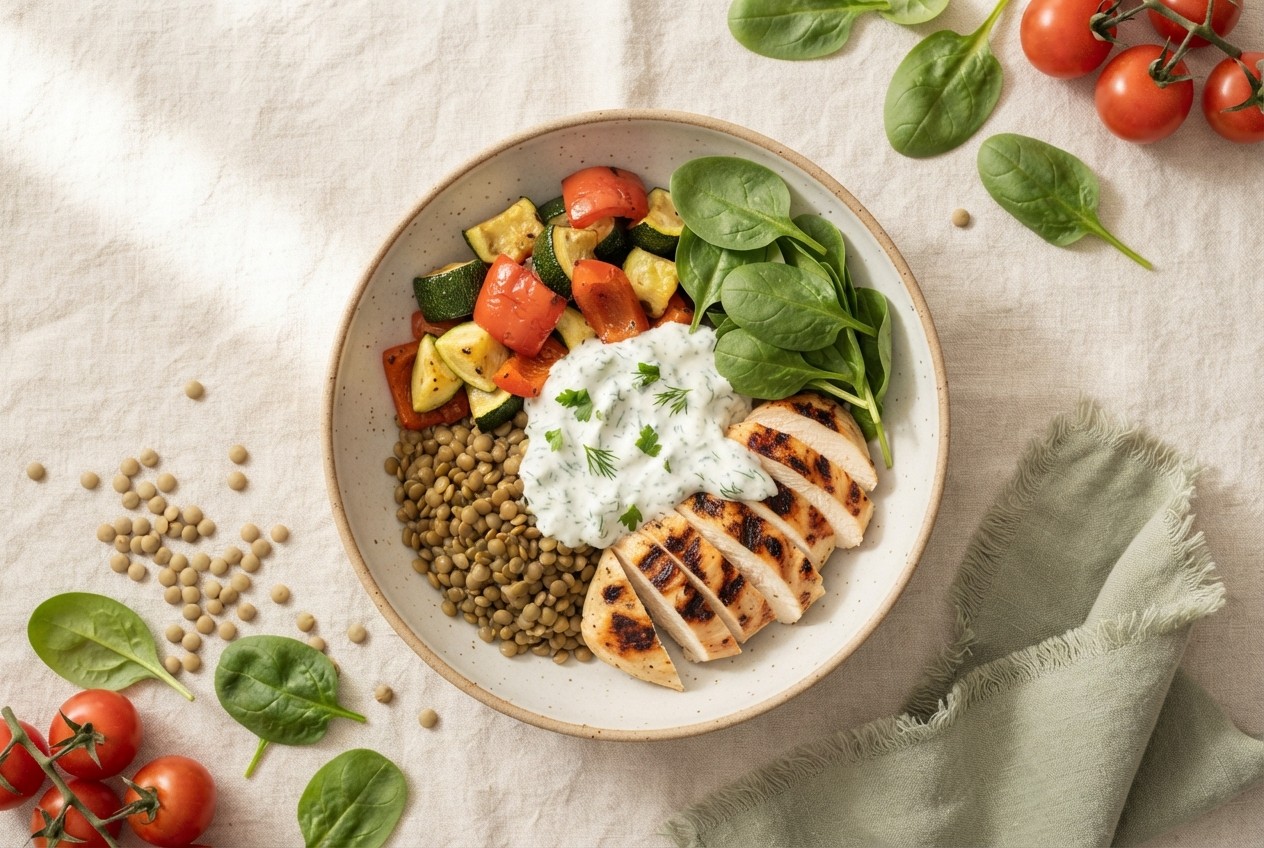
For most women with PCOS, a good daily target is 1.2–1.6 g of protein per kilogram of body weight, eaten as at least 25–30 g per meal. That is noticeably more than the general minimum — and here is why it helps, what the PCOS studies actually show, and how to hit it without blowing your calories.
Key takeaways
- The general minimum is 0.8 g/kg a day — enough to avoid deficiency, not necessarily what's best for PCOS
- 1.2–1.6 g/kg a day is the range linked to better appetite control and keeping muscle while losing fat
- Spread it out: aim for at least 25–30 g per meal rather than saving most of it for dinner
- In PCOS trials, higher protein helped weight and blood sugar a little — but weight loss itself did most of the work
- No single diet type is officially "best" for PCOS: protein is a tool for staying full, not a cure
- Lean proteins give the most protein per calorie; plant proteins add the fibre that helps insulin resistance
Contents
How much protein a day: the table
Protein needs scale with body size, so they're given in grams per kilogram of body weight (g/kg). The general minimum for adults is 0.8 g/kg a day — the amount that prevents deficiency. For appetite control and keeping muscle while you lose fat, a 2015 expert review in the American Journal of Clinical Nutrition pointed to 1.2–1.6 g/kg a day. 4
| Body weight | General minimum (0.8 g/kg) | PCOS-friendly range (1.2–1.6 g/kg) |
|---|---|---|
| 55 kg (121 lb) | 44 g | 66–88 g |
| 65 kg (143 lb) | 52 g | 78–104 g |
| 75 kg (165 lb) | 60 g | 90–120 g |
| 85 kg (187 lb) | 68 g | 102–136 g |
| 95 kg (209 lb) | 76 g | 114–152 g |
To work out your own number: weight in kg × 1.2 for the lower end, × 1.6 for the upper end. Weight in pounds? Divide by 2.2 first.
If you have a lot of weight to lose, calculating from your current weight gives a number that's hard to eat and unnecessary. Use a goal weight (or the weight a dietitian calls your "adjusted" weight) instead. Pick the lower end if you're new to eating this much protein and work up.
Why protein matters with PCOS
Protein doesn't treat PCOS. What it does is make the things that do help — steady blood sugar, a modest calorie deficit if you want to lose weight, keeping your muscle — easier to stick to:
- Fullness. Higher-protein meals leave people feeling fuller and raise satiety hormones. 4 With PCOS, where cravings and hunger are common complaints, that matters day to day.
- Steadier blood sugar. Swapping some carbohydrate for protein means a smaller glucose rise after meals — relevant because most women with PCOS have some degree of insulin resistance.
- Keeping muscle while losing fat. Higher-protein weight-loss diets preserve more lean mass than lower-protein ones. 4 Muscle is where much of your blood sugar gets used, so losing less of it is a win for insulin sensitivity.
What the PCOS studies actually show
There are only a handful of trials testing protein specifically in PCOS, and they're small. Here's an honest summary.
The Danish trial (2012). 57 women with PCOS ate either a high-protein diet (over 40% of calories from protein) or a standard-protein diet (under 15%) for six months, without counting calories. Those on high protein lost on average 4.4 kg more weight and 4.3 kg more body fat, their waists shrank more, and their blood glucose fell more — even after accounting for the weight loss. Testosterone and cholesterol didn't differ between groups. 2 The catch: only 27 women finished the study.
The Australian trial (2003). Overweight women with PCOS followed a calorie-reduced diet that was either higher protein (30%) or standard (15%) for 12 weeks, then four weeks of maintenance. Both groups lost about 7.5% of their body weight, and periods, insulin resistance and cholesterol improved in both — the weight loss drove the benefits. The higher-protein group had only small extra advantages. 3
The official guideline. The 2023 international PCOS guideline — written with input from organisations in 71 countries — concludes there is no evidence that any one diet composition beats the others for weight, metabolic, hormonal, reproductive or psychological outcomes. 1
What this means for you: eating more protein is a reasonable, well-supported way to make a healthy PCOS diet easier to stick to — fewer cravings, more muscle kept. It's not a special PCOS treatment, and a diet you can actually follow beats a "perfect" one you can't.
How much per meal (and why spreading it out matters)
Most people eat a small, carb-heavy breakfast, a moderate lunch and most of their protein at dinner. In a small 2014 study, the same total protein spread evenly across three meals (about 30 g each) produced 25% more muscle-building over 24 hours than eating most of it at dinner. 5 The expert review behind the 1.2–1.6 g/kg range also suggested meals of at least 25–30 g. 4
- Three meals a day: 25–40 g at each, depending on your daily total.
- Two meals a day (common with an eating window or intermittent fasting): each meal has to carry more — often 45–60 g. That's very doable with a lean protein plus a booster, e.g. a chicken breast with a side of Greek yogurt sauce.
- Breakfast is the meal most people come up short on. See our high-protein PCOS breakfast ideas for 30 g+ options that aren't just eggs.
The best protein sources, by protein per portion
Values are approximate, for typical cooked portions (USDA data).
| Food (portion) | Protein | Notes for PCOS |
|---|---|---|
| Chicken breast, cooked (150 g) | ~46 g | Lean — can carry a meal alone |
| White fish, e.g. cod, cooked (150 g) | ~34 g | Very lean |
| Prawns, cooked (150 g) | ~36 g | Very lean |
| Tuna, canned in water, drained (1 can, ~120 g) | ~30 g | Lean, cheap, shelf-stable |
| Lean ground beef, cooked (120 g) | ~31 g | Richer — keep portions moderate |
| Salmon, cooked (120 g) | ~27 g | Richer, but brings omega-3 fats |
| Cottage cheese (1 cup, ~225 g) | ~24–28 g | Great booster |
| Plain Greek yogurt (200 g) | ~18–20 g | Booster, sauce, breakfast base |
| Eggs (2 large) | ~12 g | Nutritious, but you need a booster to reach 25–30 g |
| Lentils, cooked (1 cup) | ~18 g | Plus ~15 g fibre |
| Edamame, shelled (1 cup) | ~18 g | Plus fibre |
| Firm tofu (150 g) | ~18–26 g (varies by brand) | Combine with another plant protein |
| Tempeh (100 g) | ~20 g | Combine with another plant protein |
Plant-based? It's entirely possible, but you'll usually need two or three sources per meal — say tofu plus edamame plus a lentil side — to reach 25–30 g. The bonus is the fibre, which helps with insulin resistance and fullness.
Getting enough protein without too many calories
This is where most high-protein plans go wrong. Fatty cuts, cheese, whole eggs and nuts bring a lot of fat — and calories — along with their protein. Three practical rules:
- Build each meal around a lean protein (chicken or turkey breast, white fish, prawns, tuna, tofu).
- Keep rich proteins moderate — around 120–180 g of salmon, beef or lamb, or two eggs — and top up with a lean booster like Greek yogurt or cottage cheese instead of a bigger portion.
- Don't add protein on top — swap. Replace some of the starch on your plate with protein rather than adding it to an already full meal.
For more on building whole days this way, see our guide to losing weight with PCOS and the PCOS nutrition guide.
Who should be careful
For people with healthy kidneys, intakes up to about 1.6 g/kg a day are considered safe. Check with your doctor or a registered dietitian first if you:
- have kidney disease or reduced kidney function
- are pregnant or breastfeeding (needs change, and your care team should guide them)
- have a history of disordered eating — tracking grams of anything can be unhelpful
Your protein target, in every meal.
HerMeal builds a 5-day PCOS meal plan around your daily protein target and calorie goal — lean proteins sized to each meal, recipes, and one grocery list for the week.
Build my free planFrequently asked questions
References
- Teede HJ, Tay CT, Laven JJE, et al. Recommendations from the 2023 International Evidence-based Guideline for the Assessment and Management of Polycystic Ovary Syndrome. J Clin Endocrinol Metab. 2023;108(10):2447–2469. PubMed 37580314
- Sørensen LB, Søe M, Halkier KH, Stigsby B, Astrup A. Effects of increased dietary protein-to-carbohydrate ratios in women with polycystic ovary syndrome. Am J Clin Nutr. 2012;95(1):39–48. PubMed 22158730
- Moran LJ, Noakes M, Clifton PM, et al. Dietary composition in restoring reproductive and metabolic physiology in overweight women with polycystic ovary syndrome. J Clin Endocrinol Metab. 2003;88(2):812–819. PubMed 12574218
- Leidy HJ, Clifton PM, Astrup A, et al. The role of protein in weight loss and maintenance. Am J Clin Nutr. 2015;101(6):1320S–1329S. PubMed 25926512
- Mamerow MM, Mettler JA, English KL, et al. Dietary protein distribution positively influences 24-h muscle protein synthesis in healthy adults. J Nutr. 2014;144(6):876–880. PubMed 24477298